Let me paint you a picture. It’s a random Tuesday evening, you’re cleaning out the kitchen drawer – you know the one – and out falls a crumpled piece of paper. You pick it up. It’s a drawing your four-year-old made of “our family” that’s mostly a purple blob with six stick legs. You have zero memory of this specific moment. But something about it punches you right in the chest.
That’s the thing about memories. They don’t always announce themselves as important while they’re happening. The birthday party photo, the hospital bracelet, the first tooth, the scribbled note from a best friend – these things end up shoved in random places and then, one day, they’re just gone.
A memory box fixes that. And not in a precious, complicated, craftsy way – in a “okay I finally have a system and everything I love actually has a home” kind of way.
I’ve been a bit obsessed with this topic lately, so I went deep on it. Here’s everything you need to know – from what box to use, what to put inside, how to do it with your kids, and a few ideas that’ll genuinely surprise you.
Plot twist: Your shoebox is not a memory box
There’s a difference between “the pile of stuff I haven’t dealt with yet” and an actual memory box. And honestly, most of us are living in the pile-of-stuff era.
A real memory box is intentional. You choose what goes in. You label things. You make it something you’ll actually want to open again in ten years – not something you’ll keep avoiding because it feels overwhelming.
Here’s the good news: it doesn’t need to be expensive, elaborate, or Pinterest-perfect. It just needs to be yours.
What kind of box should you actually use?
This is where most people overthink it. Here’s the honest breakdown:
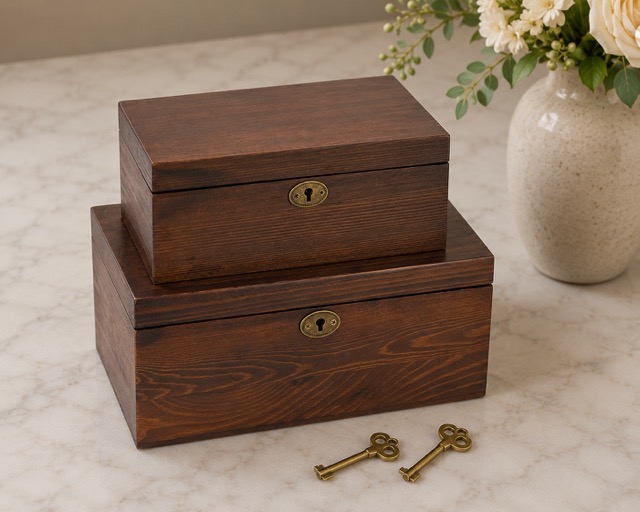
Wooden boxes are the fan favorites for a reason – they look beautiful, they’re durable, they feel special. You can get plain ones from craft stores and decorate them yourself, or buy personalized ones with names and dates already engraved. The wooden memory box with a hinged lid is basically the classic option, and it works for everything from childhood keepsakes to travel memories to a baby’s first year. A decent one costs between $20–50 on Amazon, and a personalized engraved version (hello, amazing gift idea) runs $40–80.
Acid-free archival boxes are what you want if you’re storing paper items long-term – old letters, report cards, photos, drawings. Acid-free means they won’t yellow or deteriorate over time. Less glamorous than the wooden version, but genuinely better for preservation.
The shoebox method – look, it works, and I’m not going to shame you for it. If you label it, organize it a little, and actually look at it occasionally, a shoebox is fine. The upgrade move is just getting a slightly nicer box.
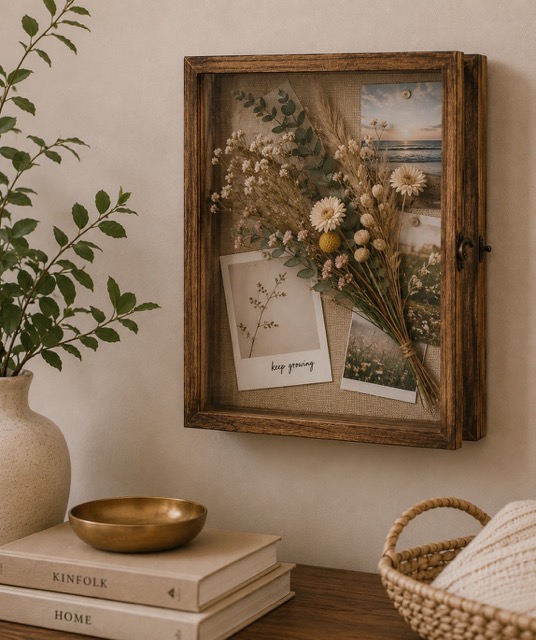
Shadow boxes are a beautiful option if you want the memory box to also be decoration – you hang it on the wall and the contents are visible through the glass front. Amazing for a child’s first year, a graduation milestone, or a wedding keepsake.
Plastic bins with lids – best for school artwork and larger items. If you’re doing one box per school year (which I’ll get to in a minute), a labeled plastic bin is actually incredibly practical.
What to put in a memory box: the master list
This is the section people are actually searching for, so I’m going to make it thorough.
🧒 Kids’ Memory Box – What to Save
If you do nothing else from this entire article, start collecting these for your child:
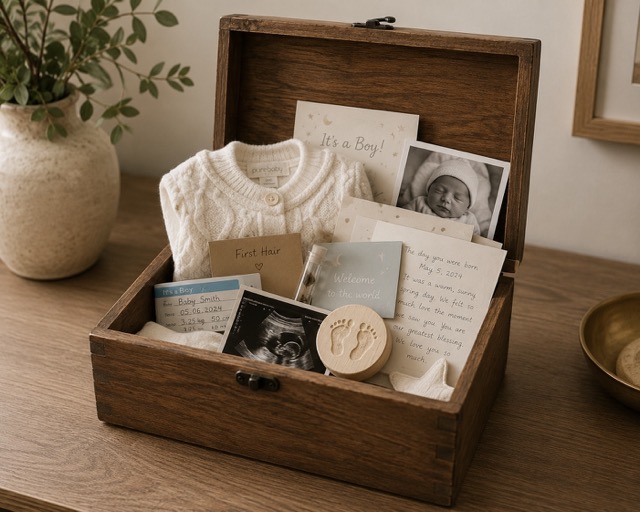
From babyhood:
- Hospital ID bracelet
- The outfit they came home in
- First lock of hair (put it in a small envelope, label it)
- Hand and footprint stamp or cast
- Birth announcement
- Cards from baby shower and birth congratulations
- A few photos from the first days – printed, not just on your phone
- Ultrasound image
- A note written in your own handwriting about the day they were born – what the weather was like, what you felt, who was there
From each school year:
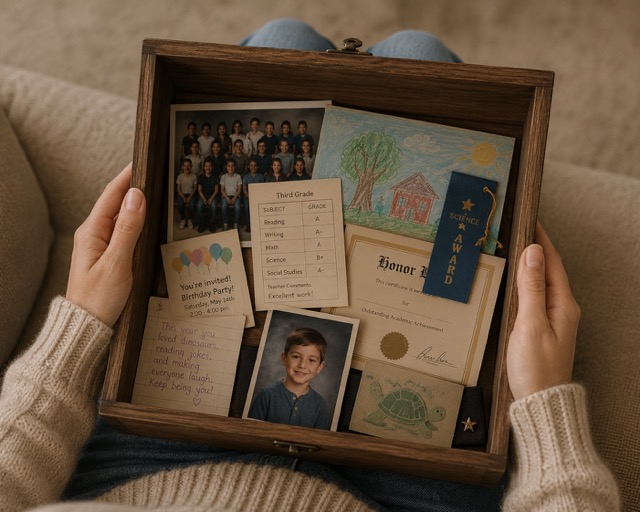
- Class photo
- A few examples of their schoolwork or artwork (not everything – pick the ones that make you feel something)
- Report card
- One or two birthday party invitations from friends that year
- Any awards, ribbons, or certificates
- A photo of them at the start of the school year
- A note from you or from them: what were they into that year? What made them laugh? What were they scared of?
The random stuff that actually matters:
- Friendship bracelets
- Notes from their best friend
- A ticket stub from their first movie, concert, or sports game
- The first book they read alone
- A small toy that was their absolute favorite (if it’s small enough to fit)
- A drawing they made of your family
- Their first lost tooth (in a tiny labeled bag – trust me)
Plot twist: Ask your kids to pick one thing per season to put in the box. At age 5 they’ll pick a rock or a sticker. At age 10 they’ll pick a note from their best friend. Both are perfect.
🧸 Kids’ School Memory Box – The Per-Year System
This one deserves its own section because it solves a very specific parent problem: the mountain of paper that comes home from school every single week and somehow multiplies overnight.
The system that works:
Keep a large envelope or folder on top of your fridge or inside a cabinet. Throughout the year, things go in there – drawings, tests, projects, the class photo when it arrives. At the end of the school year, you sit down together with your child, go through the pile, and they pick their favorites. Everything else can go. The favorites go into their memory box for that grade.
Label each box or section with the school year and grade. In twelve years, you’ll have a complete record of their childhood — not an overwhelming archive of every crayon scribble, but the actual highlights.
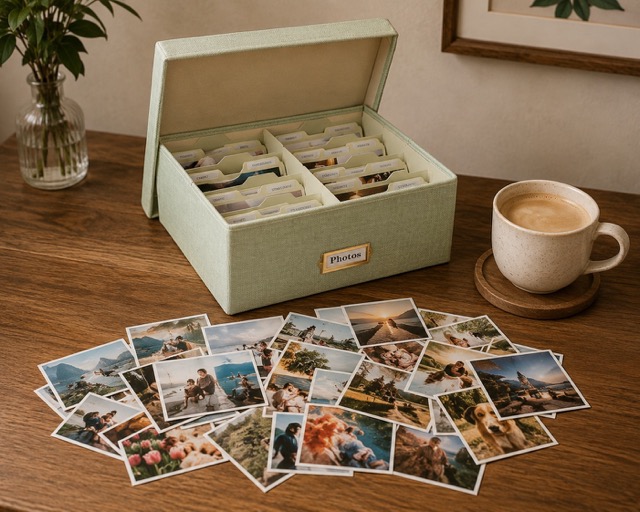
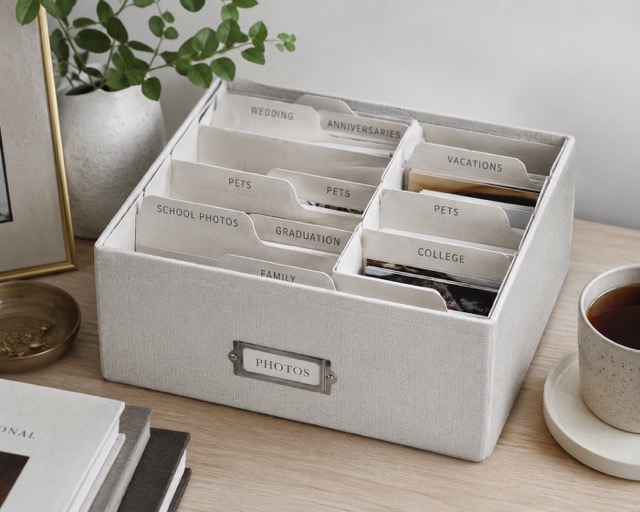
This photo organizer box is my absolute favorite – it has labeled sections for every life milestone and finally makes sense of all those loose photos. Grab it here!
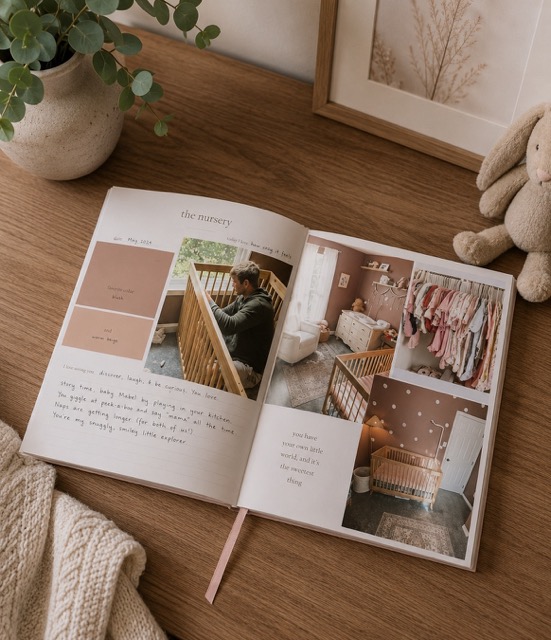
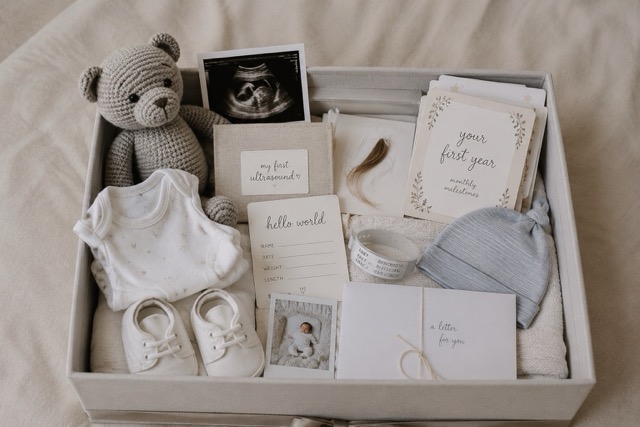
👶 Baby’s First Year Memory Box
If you’re a new parent, this is the one to start immediately because the first year goes so fast it’s almost cruel.
Dedicate one beautiful box just to year one. Include:
- Hospital bracelet (both baby’s and mom’s if you want)
- Coming-home outfit
- Monthly milestone cards (there are gorgeous printable sets you can download – more on this in a minute)
- Hand and footprints – do this in the first week while they’re tiny
- Lock of hair from first haircut
- Baby shower cards and birth congratulations
- First ultrasound photo
- First shoes
- A few of the cutest onesies, folded flat
- Newborn hat from the hospital
- A written letter from you to them about the day they were born
And this one’s my favorite idea: write a short note every month of the first year. It doesn’t need to be long. “You said ‘dada’ today and then laughed like you knew exactly what you’d done.” Tuck them all in an envelope in the box. When they’re 18, this will destroy them (in the best way).
This baby book is absolutely lovely. The illustrations are beautifully detailed, and the story is gentle, engaging, and perfect for nurturing a love of reading from an early age. The quality of the pages is excellent!
✈️ Travel Memory Box
This is for the parents who actually want to remember the family trips they took, not just have 4,000 photos they never look at.
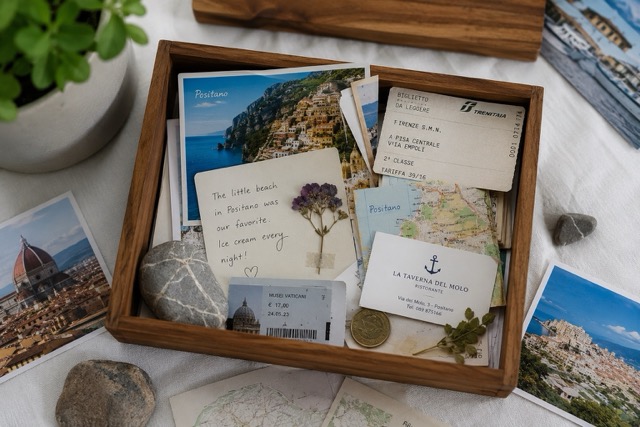
What works in a travel memory box:
- Postcards (buy them even if you don’t send them – they’re flat, beautiful, and carry the vibe of a place perfectly)
- Ticket stubs: museums, trains, theme parks, ferries
- Maps with your route highlighted
- A small local item from a market or shop – a coin, a postcard, a pressed flower
- A restaurant business card or menu from your favorite meal
- A handwritten note from each trip: what was the best moment? What surprised you? What would you go back for?
The trick: have each kid add one thing from every trip. Even a small child can pick a rock or a sticker from a gift shop. At the end of the trip, everyone’s contribution goes in the box. Years later, when you open it, everyone will remember different things – and that’s what makes it magic.
This box is simply amazing. Great quality, very well made.
💍 Wedding & Anniversary Memory Box
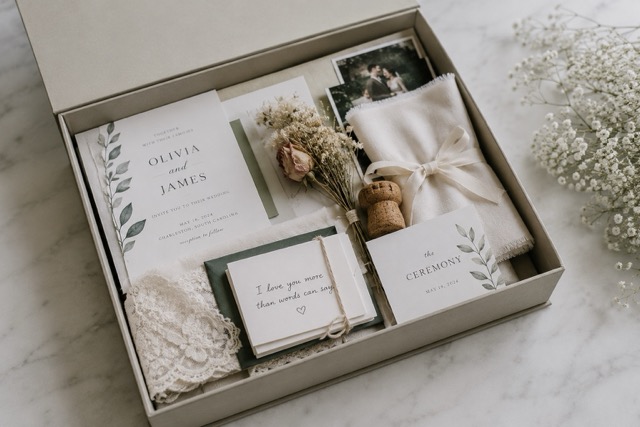
Beyond the photo album (which you probably also don’t look at enough), a wedding memory box holds the three-dimensional stuff.
- The invitation suite – save the date, invitation, any inserts
- A dried flower from the bouquet
- Fabric swatch from the dress or bridesmaid dresses
- The ceremony program
- A copy of your handwritten vows (the actual paper, not a printout)
- Cards from guests with the most meaningful messages
- The champagne cork from the toast
- A small piece of wedding cake topper if you have one
For anniversaries: add one small thing every year. A movie ticket from a date night. A photo from a trip you took. A note written to your partner about your favorite memory from that year. In twenty years, this becomes an extraordinary document of your life together. And if you’re looking for a beautiful box to store it all in, this wooden memory box is exactly what I’d pick.
🌿 Nature Memory Box (especially for kids)
This one is so underrated and so easy to start with children of any age.
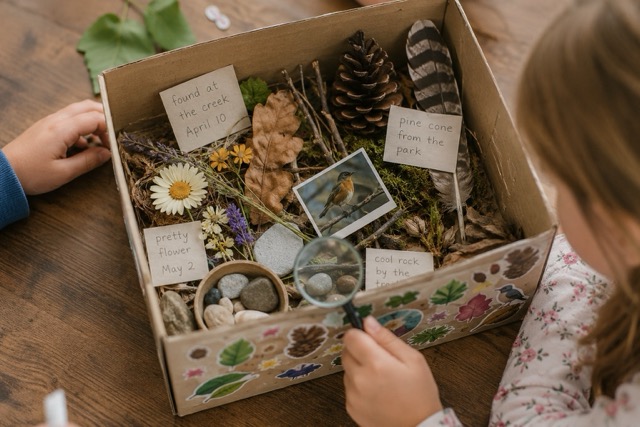
A nature memory box collects the small beautiful things from outdoor time:
- Interesting rocks, shells, or pebbles (label where you found them)
- Pressed flowers and leaves (press them in a heavy book for a week first, then store flat in the box)
- A feather you found on a walk
- Pine cones
- A dried seed pod
- A photo of a bug, bird, or animal you saw
This naturally connects to outdoor play and helps kids actually pay attention to what’s around them instead of rushing past it. Plus, it’s completely free and requires zero prep.
A Memory Box for Someone You’ve Lost
Some memory boxes aren’t about capturing a season or a milestone – they’re about holding onto a person. A jewelry box or small wooden chest can become the most meaningful keepsake of all when it’s filled with the small everyday things that belonged to someone you loved. A ring she always wore. A handkerchief. A tiny perfume bottle. A handwritten note. A photo from when she was young.
These aren’t just objects – they’re the texture of a life. And keeping them together in one beautiful box means you can open it whenever you need to feel close to her again.
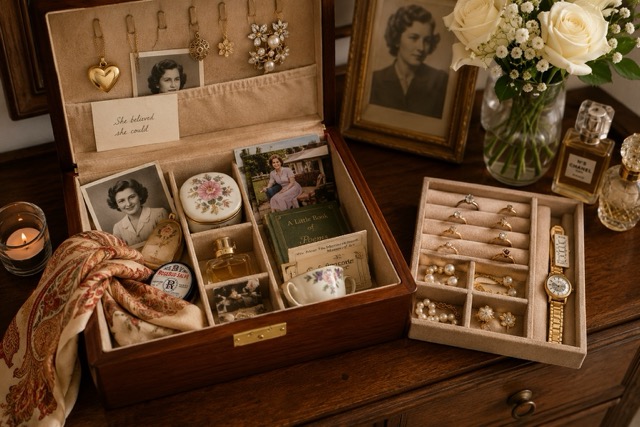
The Recipe Memory Box
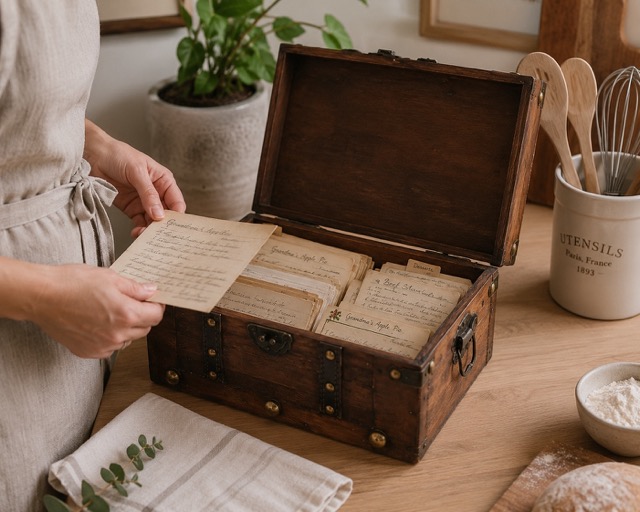
There’s a kind of magic in food that no photo can replicate. A smell, a taste, a texture – and suddenly you’re back at your grandmother’s kitchen table, eight years old, watching her hands move without measuring anything.
Recipes passed down through family are some of the most precious things we own – and most of us keep them on a crumpled piece of paper shoved in a drawer, one spill away from being gone forever.
A wooden recipe box changes that. Gather the handwritten cards, the stained notebook pages, the recipes scribbled on the back of envelopes – and give them a home that honors what they actually are: a piece of your family’s story. You can’t go back to those moments. But you can cook the same food, sit at your own table, and be there for just a little while.
How to decorate a DIY memory box (without it taking all weekend)
The most popular search term in your Pinterest screenshots was “memory box ideas diy paint” – and I get it, the decorated ones look so good. Here’s the honest version:
For kids: A plain wooden box + craft paint + stickers + a photo glued to the lid = done. Kids LOVE doing this themselves. Let them go wild. The “imperfect” paint job is part of the charm. You can also use Mod Podge to decoupage a photo or patterned paper onto the lid.
For something prettier: Choose one or two colors, use chalk paint (it doesn’t require sanding or priming and it dries matte and beautiful), and add a simple stenciled design or just write the person’s name in a nice pen. Done.
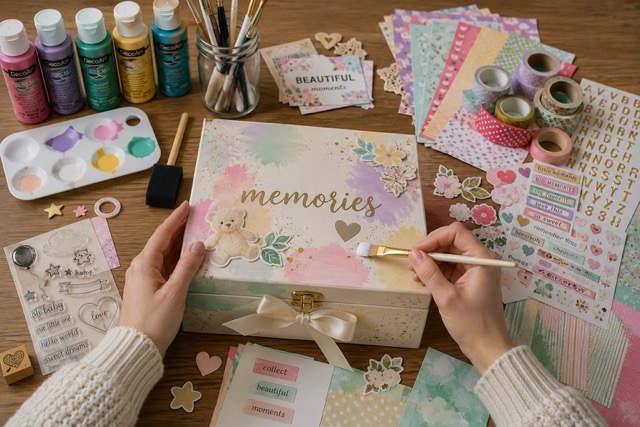
How to Decorate a Memory Box in 5 Easy Steps:
- Clean and prep the box. Wipe away any dust. If the wood is shiny or sealed, a quick once-over with fine sandpaper helps the paint stick better (totally optional for craft-store boxes).
- Paint the base coat. Use chalk paint or acrylic paint in one or two colors. Two thin coats look better than one thick one – let it dry fully between coats (about 30 minutes).
- Add the focal point. This is your one “wow” element: a pressed flower under decoupage, a hand-painted bouquet, a large monogram, or a beautiful sticker centered on the lid.
- Layer in the small details. Washi tape along the edges, a few coordinating stickers, a stamped word like “memories” or a name written in a nice pen. Less is more here – pick 2–3 details, not ten.
- Seal it (optional but worth it). A thin coat of Mod Podge or matte sealant over the whole design protects it and gives it a slightly polished finish.
Total time: about an hour, including drying time. And the “imperfect” version will still look beautiful — that’s the whole charm of doing it yourself.
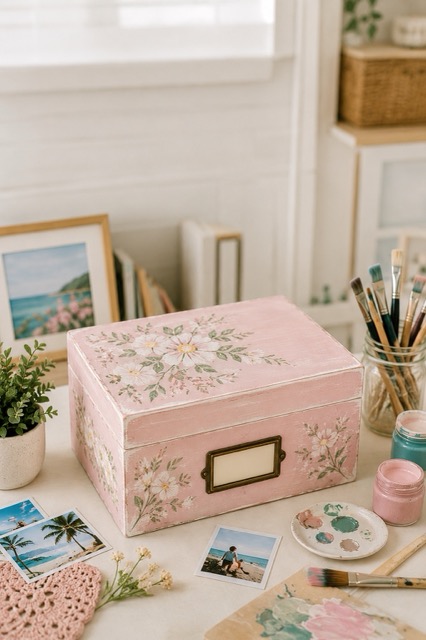
Supplies you actually need:
- Chalk markers set or acrylic paint
- A small foam brush
- Mod Podge if you’re decoupaging
- Washi tape collection for a quick, no-paint option that still looks lovely
- Stickers, stamps, or letter stencils for names or dates – this set was perfect for my memory box
The shortcut: If decorating isn’t your thing, buy a pre-made box that’s already beautiful. There’s absolutely no shame in this. A lovely wooden box with a simple label is more likely to actually get used than an unfinished craft project.
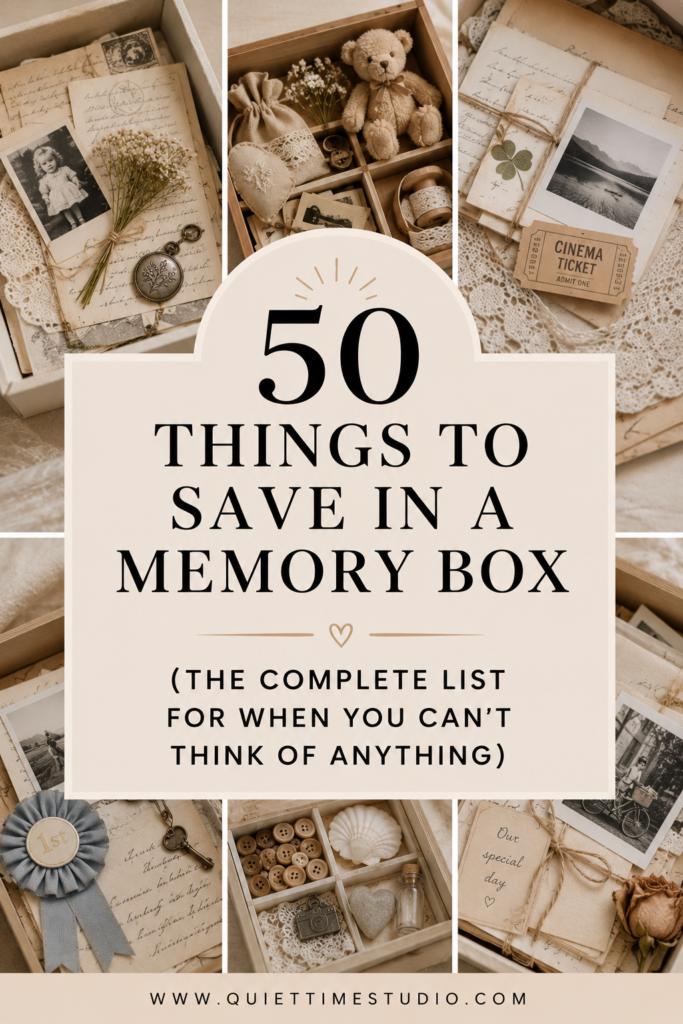
50 Things to Save in a Memory Box (the complete list for when you can’t think of anything)
Because sometimes you just need the list:
From childhood:
- First drawing of the family
- First tooth in a labeled envelope
- Hospital bracelet
- Coming-home outfit
- First lock of hair
- Monthly milestone cards
- First ultrasound photo
- Handprint or footprint stamp
- First shoes
- Favorite small toy (if it fits)
- Class photos by year
- Report cards
- Friendship bracelet
- Note from a best friend
- Ribbon or certificate from a school achievement
- Birthday party invitation
- Ticket stub from first movie or concert
- A page of their first journal
- Something they made at summer camp
- Their own description of their favorite thing at age 5 / 8 / 10 (ask them, write it down)
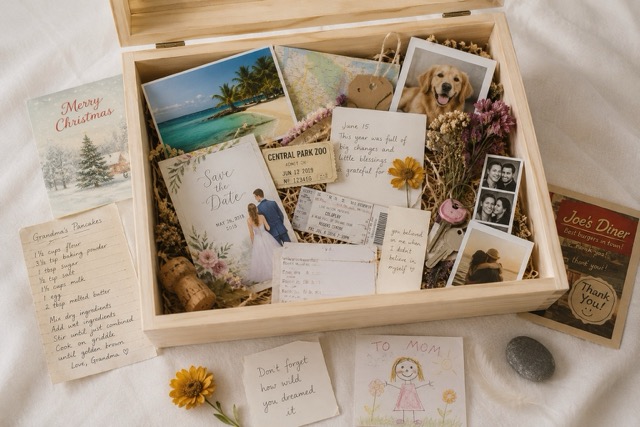
From family life: 21. A family Christmas card from each year 22. A photo from every vacation, printed 23. Postcard from a trip 24. Ticket stubs from museums or attractions 25. A map with your route highlighted 26. A restaurant card from your favorite meal away 27. A note about what life was like this year (do this annually – it becomes extraordinary over time) 28. A pressed flower from your garden 29. A recipe in grandma’s handwriting 30. A letter written to your future self or your child 31. A wishlist your child wrote to Santa 32. A drawing your child made of you
From big life moments: 33. Wedding invitation suite 34. Dried bouquet flower 35. Ceremony program 36. Copy of vows 37. Champagne cork from a celebration 38. Graduation program 39. Acceptance letter 40. First paycheck stub 41. Keys to first apartment (or a photo of them) 42. Card from a mentor who believed in you
Small beautiful things: 43. A shell from a beach you loved 44. A feather found on a walk 45. A pretty pebble or rock 46. A ticket stub from a concert that changed something in you 47. A note from a stranger that made your day 48. A photo of a pet 49. Something handmade by someone you love 50. A photo printed from your phone of a totally ordinary moment – a Sunday morning, a regular dinner – because those are the ones you’ll want most
The Concert & Events Memory Box
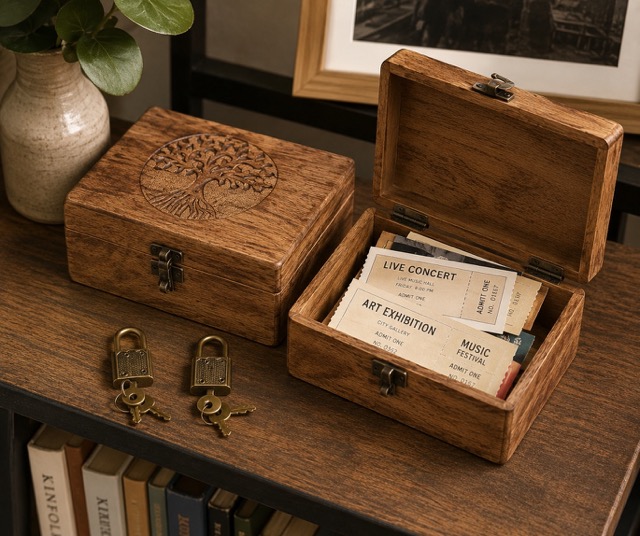
Some nights just deserve to be kept. The concert where you knew every word. The art exhibition you almost didn’t go to. The music festival where something shifted a little inside you.
Ticket stubs are the smallest, flattest proof that you were there – and they fit perfectly in a small wooden box like this one. Tuck in a photo, a wristband, a setlist if you managed to grab one, maybe a short note about who you went with and what song made the whole room go quiet.
Memory box ideas for kids to make as gifts
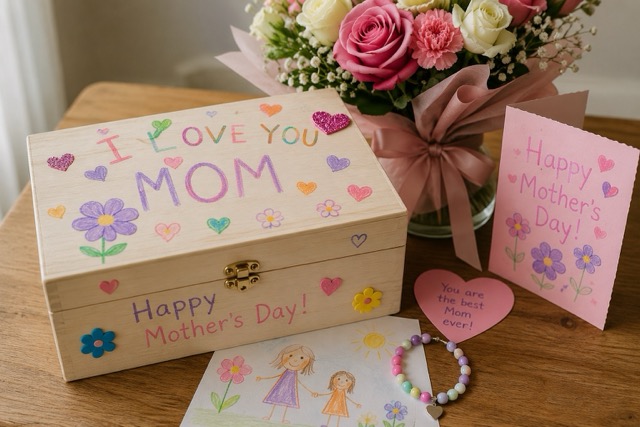
This is a beautiful activity for kids ages 6 and up, and the result is something the recipient will actually treasure.
What you need:
- A plain wooden or cardboard box (craft stores sell them for a couple of dollars)
- Craft paint or stickers to decorate the outside
- Items to fill it with: printed photos, a handwritten note, a pressed flower, a small drawing, a friendship bracelet, a favorite candy
Have your child decorate the outside of the box themselves. Then together, fill it with small things that represent your relationship with the recipient – a photo of you together, a note about a shared memory, something from a place you both love.
This makes an extraordinary birthday gift, a Mother’s Day or Father’s Day gift, or a going-away gift for a friend who’s moving. And it costs almost nothing.
Digital memories: don’t forget your phone
Here’s the thing nobody talks about in memory box articles: 90% of your photos live on your phone and will never, ever be printed. And when you upgrade your phone in a few years, something will go wrong, or the backup won’t work, or the old app won’t be supported, and some of those memories will just be gone.
The solution is simple and doesn’t need to be a whole project:
- Once a year (January 1st works well, or your child’s birthday), go through your camera roll.
- Pick 20–30 of your favorite photos from that year.
- Print them. A 4×6 print costs almost nothing – there are apps like Chatbooks or Artifact Uprising that do this beautifully, or you can just use a drugstore photo printer.
- Tuck them in an envelope labeled with the year and put them in the memory box.
That’s it. Twenty minutes, once a year. Your kids will thank you for this in thirty years.
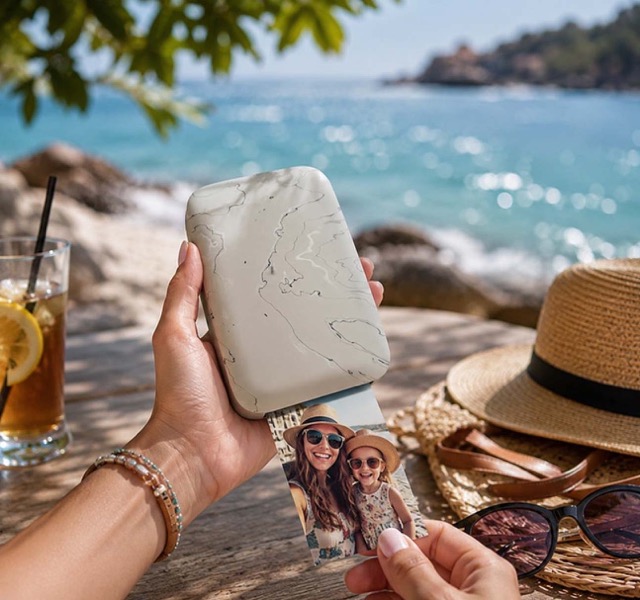
My personal favorite for this is a mini photo printer that connects straight to your phone – no cables, no fuss. Small enough to fit in your purse, and it prints on photo sticker paper which is honestly a game changer. The kind of thing you buy once and wonder how you lived without it.
Memory box organization: the system that actually works
The biggest problem with memory boxes isn’t starting them – it’s keeping them from becoming chaos.
This is why I love the “inbox” approach. That vintage drawer cabinet you see here? It’s not a memory box itself – it’s the landing zone for everything that needs to find its home eventually. After every trip, every season, every school concert, everything lands here first. The postcard, the ticket stub, the little stone your kid picked up on the beach. No pressure, no decision required in that moment.
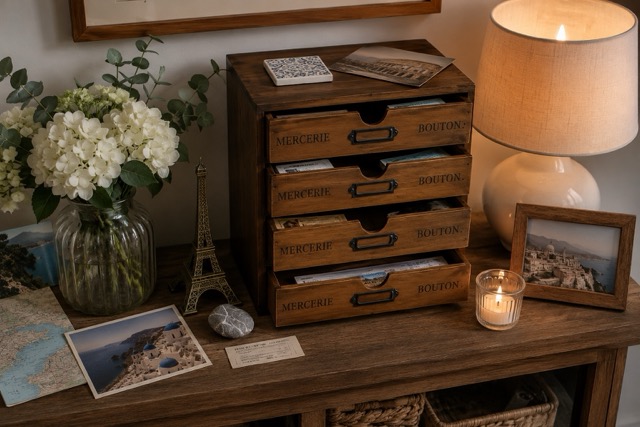
Then, once a season – or whenever a rainy Sunday calls for it – you sit down with a cup of coffee and sort through it. Some things go into the travel memory box. Some into the kids’ school box. Some you realize don’t actually need to be kept at all.
A few more things that keep the whole system working:
Label everything. A baby shoe without a label means nothing in twenty years. A baby shoe with a Post-it that says “first steps, October 2022” is a treasure.
Add context in writing. Memory fades. Handwriting stays.
One box per category or time period. Mixing everything together makes it overwhelming to open. Separation makes it feel like a gift.
Review once a year. Not just storage – actually revisiting. Put it in your calendar.
Use small envelopes and ziplock bags inside the box. Locks of hair, teeth, tiny notes – they disappear at the bottom otherwise.
A printable memory box system you can use right now
Here’s where I come in as your secret weapon. Because I know that the thing standing between you and actually doing this is a blank piece of paper. Nobody knows what to write. Nobody wants to figure out the format.
That’s why I created a Memory Box Starter Kit – a set of printable cards and pages you can download, print at home, and tuck right into your memory box. It includes:
- Annual memory cards – fill out once a year for each child (age, height, favorite things, best memory, funniest thing they said)
- Monthly baby milestone cards – for the first year, one card per month
- “Day I Was Born” letter template – prompts to help you write the birth story letter you keep meaning to write
- Travel memory cards – one per trip, with prompts for the best moment, funniest thing that happened, and what you’d go back for
- “Things I Never Want to Forget” free-write page – blank but beautiful, for the stuff that doesn’t fit anywhere else
All of it designed to print at home on regular paper, sized to fit in a standard memory box.
[LINK DO FREEBIE / ZAPISU DO NEWSLETTERA]
Q&A – Questions people actually ask about memory boxes
What size memory box should I get? Depends what you’re storing. For a baby’s first year, you want something at least 12x10x6 inches – you’ll need room for the coming-home outfit, shoes, and larger cards. For an annual school box, a standard letter-size file box or a 13x10x4 inch flat box works beautifully. For a travel memory box, a smaller decorative box is fine since you’re mainly storing flat items like tickets and postcards.
How do I keep paper items from yellowing and deteriorating? Two things: acid-free storage materials, and keeping the box away from direct sunlight and humidity. The bathroom is a terrible place for a memory box. A bedroom closet shelf is great. If you’re storing very precious items like old letters or photos, use acid-free tissue paper between layers and add a silica gel packet to absorb moisture.
My kids have SO much artwork – I can’t save all of it. What do I do? You’re right, you cannot save all of it, and you shouldn’t try. The system I mentioned earlier (folder on the fridge throughout the year, then sit down with your child at the end of the year and pick favorites) works beautifully. Alternatively: photograph everything with an app like Artkive before recycling it. You get a digital record of all of it, and the physical pieces that go in the box are only the truly special ones.
Is it okay to make a digital memory box instead of a physical one? Yes, but I’d do both. Digital is great for photos and video. Physical is irreplaceable for three-dimensional items and handwritten things. There is genuinely nothing like holding a letter written in someone’s handwriting, or seeing how small those first shoes were. A screen can’t do that.
What’s a good memory box idea for a gift? A beautiful blank memory box with a handwritten note inside explaining what it’s for is a deeply meaningful gift – especially for a new parent, a graduate, or someone going through a big life transition. If you want to make it extra special, add a few items to get them started: a card with a prompt to fill in, a pretty pen, a small photo envelope, and maybe a printed photo of the two of you together.
You don’t need to do it perfectly. You just need to start.
Here’s the honest truth about memory boxes: the bar is “better than a shoebox under the bed.” It does not need to be a Pinterest masterpiece. It does not need to be finished today.
Start with one box. One label. One thing you’ve been meaning to save but haven’t gotten around to. That tooth your kid lost last month. That drawing from kindergarten. That ticket stub from the concert you still think about.
Put it somewhere real. Somewhere you can find it. Somewhere it will actually get added to.
That’s a memory box. And it’s more than most people ever do.
If you liked this, you’ll also love our posts on Screen free activities for kids and Summer bucket list. Because the best memories don’t happen on screens – they happen in the real world, in the middle of ordinary days, when you’re paying attention.